
How Do You Trust a Brand You Can Only Buy Online?
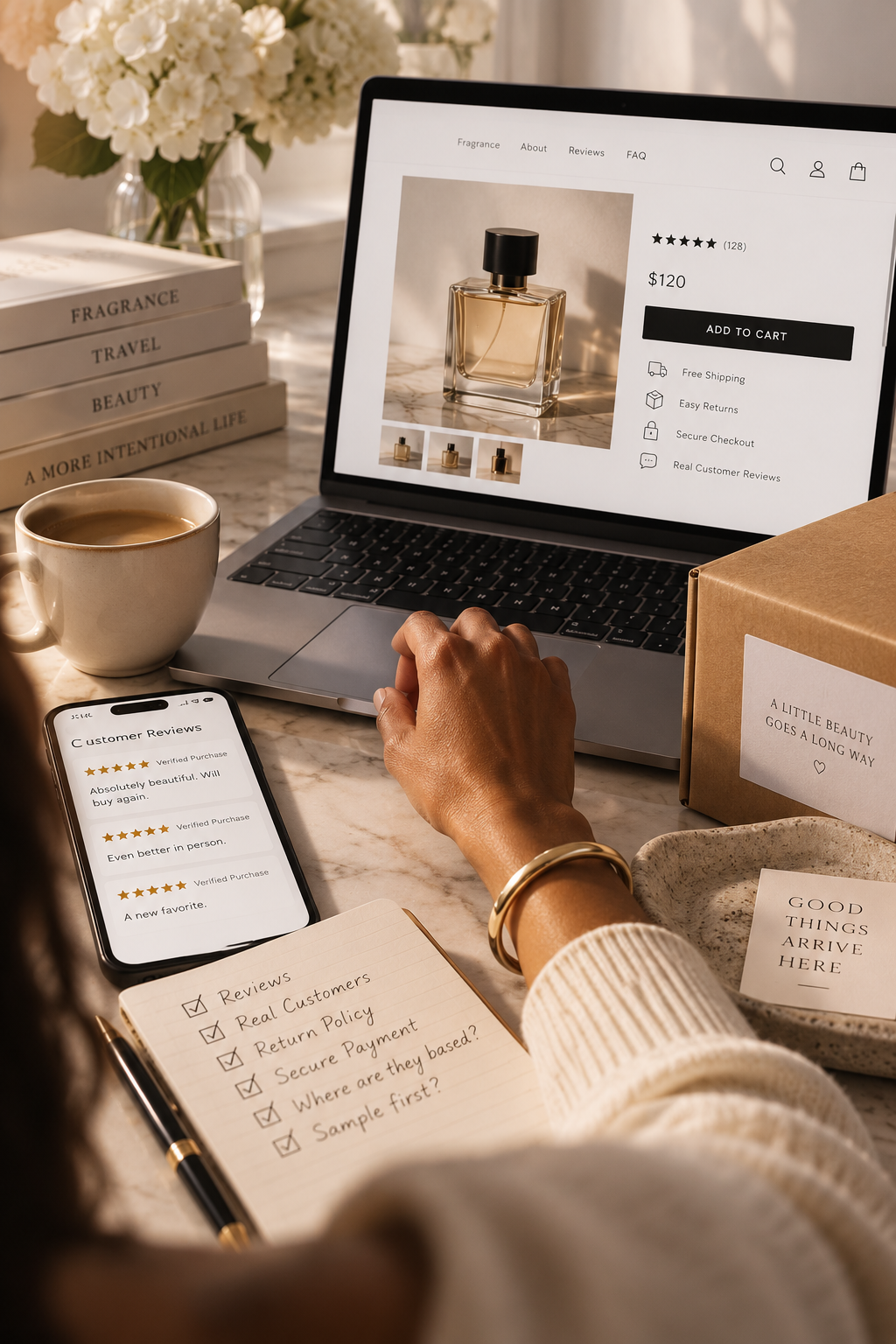
I buy things online all the time, but recently I started thinking about how strange the transaction actually is.
We give our money to companies we have never visited, for products we have never touched, made by people we have never met.
And in fragrance, we take it one step further.
We are asking you to buy something through a screen that you cannot even smell.
That made me wonder: what actually makes us trust a brand that exists primarily online?
I went looking for the answer, and I realized that online trust is built through a collection of small signals we are constantly evaluating, often without realizing it.
Before we buy the product, we investigate the brand
Think about the last time you landed on the website of a company you had never heard of.
You probably did not immediately click "add to cart."
You looked around.
Is the website professional? Are there real customer reviews? Does the company have a social presence? Can you find information about who is behind it? Is checkout secure? What happens if you need to return something?
Research from YouGov published in 2026 found that 69% of U.S. adults check customer reviews when verifying an unfamiliar online retailer, while 65% look for secure payment options. Verified-purchaser reviews were particularly important.
In other words, before many of us decide whether we trust the product, we are looking for evidence that we can trust the company selling it.
We're not looking for perfection. We're looking for proof.
This is where things became more interesting to me.
A beautiful website can make a brand look established. Great photography can make a product desirable. A polished Instagram account can create an entire world around it.
But none of those things, by themselves, prove that the experience on the other side of the checkout button will match what we have been shown.
Consumers have become very good at looking for additional evidence.
Reviews from actual customers. Press coverage from publications they recognize. Retail partners. Customer photographs. A founder who visibly exists. Clear shipping and return policies. Contact information. Years of activity rather than a website that appeared yesterday.
Not every brand will have every one of those things, particularly when it is new. But together, these signals begin answering the question sitting quietly underneath an online purchase:
Is this real?
Fragrance has an even bigger problem
Now imagine trying to build that trust when the most important characteristic of your product cannot travel through the screen.
You can see the color of a dress online.
You can watch a video of a handbag being opened.
You can read the dimensions of a piece of furniture.
But I can describe a perfume as having pear, jasmine, orange blossom, warm musk and wood, and you still do not know exactly what it smells like.
Even the language we use to describe fragrance is subjective. "Warm" means something different to different people. So does "fresh." So does "sexy."
That is part of what makes fragrance fascinating, but it also makes selling perfume online unusually difficult.
A fragrance brand is essentially asking a customer to trust a description of a sensory experience they cannot have yet.
This is why sampling became so important
Once I started looking at the problem this way, the rise of fragrance discovery sets made even more sense.
Discovery sets are now offered across the fragrance market, from independent houses to major luxury brands and retailers. They solve a very specific problem: they allow the physical product to finish a job the website cannot.
Instead of asking someone to trust a description enough to commit to a full bottle, sampling lets them wear the fragrance on their own skin, live with it for several hours and come back to it another day.
That distinction matters because perfume is not something I believe you truly understand from a list of notes or even from the first few minutes after spraying it.
It has to live with you for a while.
That is also why I have written before about how fragrance can behave differently on your skin. There are parts of the fragrance experience that no amount of digital storytelling can replace.
Discover MAIR
Three fragrances. One might feel like you.
Experience Remember When, Peony Silk and Acqua Di Lusso before choosing your full-size fragrance.
Explore the Discovery KitTrust doesn't end when someone clicks "buy"
This may be the part brands underestimate.
Getting someone to place the first order is not the end of building trust. In some ways, it is the beginning.
Now the customer is waiting to find out whether everything you told them was true.
Will the product look like the photograph?
Will it arrive when you said it would?
Will the packaging feel as considered in their hands as it looked on the website?
If something goes wrong, will a real person answer?
Research into online shopping has found that consumer trust can reduce perceived risk and improve satisfaction with the shopping experience. That makes sense to me because so much of ecommerce is really an exercise in uncertainty.
Every promise a brand keeps removes a little more of it.
Being available somewhere else changes the equation too
There is another trust signal that I understand much better now from the brand side: third-party validation.
Seeing a brand carried by a retailer, mentioned by an established publication or recommended by someone you already trust changes the calculation.
It does not automatically mean the product is right for you, but someone else has put their reputation beside the brand.
For an independent company, that matters.
It is one reason retail has always meant more to me than simply another place to sell MAIR. Being able to experience a fragrance in person removes one of the biggest barriers that exists online, while being selected by a retailer provides another layer of validation for someone discovering the brand for the first time.
The website tells you what the brand says about itself.
Sometimes we want to know what everyone else says too.
Maybe trust online is really about reducing uncertainty
I started this rabbit hole thinking online trust was mostly about reputation.
I came out of it thinking it is really about reducing uncertainty.
Every part of an online brand is answering questions the customer may never actually say out loud.
Is this company real?
Are these reviews real?
Will this look like the picture?
Will my order actually arrive?
Will someone answer me if something goes wrong?
And perhaps the biggest one:
Will I regret giving you my money?
A good website can make someone want a product.
Building enough trust for them to actually buy it is a completely different job.
And when the product is something they cannot touch, try or even smell through the screen, that trust may be one of the most important things a brand sells.
Find Your Scent
What fragrance feels like you?
Not sure which MAIR fragrance is yours? The quiz takes 60 seconds.
Take the Scent Quiz →