How Social Media Changed Fragrance Packaging
There was a time when a perfume bottle had one primary place to perform: the fragrance counter.
It needed to catch your eye from a shelf, feel substantial when you picked it up and communicate something about the fragrance before you ever removed the cap.
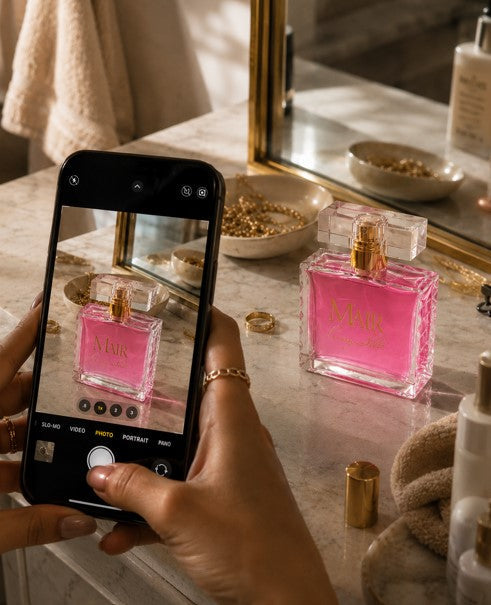
Now the first place you encounter a perfume bottle may not be a store at all. It might be three inches tall on your phone.
That seemingly small change has created an entirely new design problem for fragrance brands.
A bottle now has to survive the shelf, the bathroom vanity, the unboxing video, the product page, the Instagram grid and the half-second scroll past it on TikTok. What looks beautiful in your hand doesn't necessarily photograph well. What stops someone on a screen doesn't necessarily feel luxurious once it reaches their bathroom.
Somewhere between those two realities, fragrance packaging started changing.
Before Instagram, the shelf was the screen
Perfume packaging has always been marketing.
Long before social media, a bottle had to distinguish itself from dozens of competitors sitting beside it at a department store counter. Shape, glass, color, weight and even the sound of a cap clicking into place could communicate luxury before a customer smelled what was inside.
Some bottles became recognizable enough that you could identify the fragrance from its silhouette alone.
We've written before about how perfume packaging influences consumer perception. That relationship hasn't disappeared. What has changed is where that perception increasingly begins.
The shelf is no longer the only place a bottle has to compete.
Then the thumbnail became a storefront
Think about the last fragrance you discovered online.
You may have first seen it in someone's hand on TikTok, sitting on a vanity on Instagram or reduced to a tiny product image while scrolling through a retailer's website.
That changes what packaging needs to accomplish.
A subtle design that feels extraordinary when you're holding it can disappear on a small screen. Meanwhile, a distinctive color, recognizable silhouette or unusual cap can make a bottle identifiable before someone can even read its name.
This matters because social media has already changed how consumers discover fragrance. Perfume is an invisible product being sold on overwhelmingly visual platforms. The bottle has increasingly become the visual shorthand for something the screen cannot actually communicate: smell.
In other words, packaging isn't simply protecting the fragrance anymore. Online, it sometimes has to stand in for the fragrance itself.
Unboxing gave the box a job too
Then came unboxing.
Secondary packaging used to have a fairly straightforward purpose: protect the bottle, present it beautifully and communicate the brand.
Now opening the package can become content.
The tissue paper, box construction, reveal, insert cards and placement of the bottle can all end up on camera. An experience that was once private between a customer and a product can now be watched by thousands of potential customers.
For brands, that's both an opportunity and a complication.
Packaging now has to work in someone's hands and through someone else's camera.
Discover MAIR
Three fragrances. One might feel like you.
Experience Remember When, Peony Silk and Acqua Di Lusso before choosing your full-size fragrance.
Explore the Discovery KitThe problem with designing for the algorithm
This is where the conversation gets more complicated.
Designing something that looks good online isn't inherently bad. A beautiful object should photograph beautifully. But the priorities of a screen and the priorities of everyday use aren't always the same.
A dramatic bottle might be instantly recognizable online but awkward to hold. An oversized cap might create a memorable silhouette while making the bottle harder to store. Elaborate packaging can make an unboxing impressive while adding material, weight and shipping costs that disappear from the customer's mind five minutes after opening it.
There is also the temptation to make products louder simply because loud things are easier to notice while scrolling.
Fragrance isn't alone in this. Beauty products increasingly live two lives: the one we see online and the one that actually sits in our bathrooms.
The question for brands is whether those two lives are beginning to ask too much of the same object.
Your bathroom is still the final test
A customer may discover a fragrance in six seconds on her phone, but she may live with that bottle for six months or several years.
That changes the definition of successful design.
Does the atomizer work beautifully every morning? Does the bottle feel good in the hand? Can you tell how much fragrance is left? Does it fit comfortably on a vanity? Does the design still feel special after the novelty of the unboxing is gone?
Those questions aren't particularly exciting on social media.
They matter enormously in real life.
We've also seen social media transform fragrance itself into something increasingly collectible. Entire perfume closets containing hundreds of bottles have become content, which raises another interesting question: when a bottle is designed to be displayed, photographed and collected, does that subtly change our relationship with the fragrance inside it?
The bottle still has to protect what's inside
For all the conversation about aesthetics, perfume packaging has a practical job that hasn't changed.
It has to protect the fragrance.
Light, air, temperature and storage conditions can affect fragrance over time, which means bottle design is never purely decorative. The materials, closure, atomizer and glass all exist in service of the formula as much as the visual identity.
That becomes easy to forget when packaging is being judged through a photograph.
It is also why the final bottle is only one part of a much longer process. From sourcing ingredients and developing the formula to maceration, filtration, filling and packaging, making perfume involves far more than designing something beautiful enough to sit on a vanity.
So what does a great perfume bottle need to do now?
Probably more than at any other point in fragrance history.
It needs to be recognizable without becoming a gimmick. Beautiful enough to stop someone online, but functional enough to disappear effortlessly into her morning routine. It needs to survive manufacturing and shipping, protect the fragrance inside, communicate the identity of the brand and increasingly contend with questions around materials and waste.
And yes, it has to photograph well.
The challenge isn't choosing between the internet and the bathroom.
The best design should understand that the customer exists in both places.
Find Your Scent
The bottle might get your attention. The fragrance still has to earn a place on your skin.
Not sure which MAIR fragrance is yours? The quiz takes 60 seconds.
Take the Scent QuizThe first impression isn't the entire relationship
The perfume bottle has more jobs than it has ever had.
It has to sell from a screen without being touched, photograph beautifully without becoming a gimmick, survive shipping, live comfortably on a vanity and still make someone want to pick it up months after the unboxing video has disappeared from her feed.
Social media may have changed where the first impression happens.
The best perfume packaging remembers that the first impression isn't the entire relationship.