Perfume Notes Explained: Why Your Favorite Fragrance Note Might Not Be What You Think

The fragrance note listed on the box and the one you're actually smelling are often two completely different things.
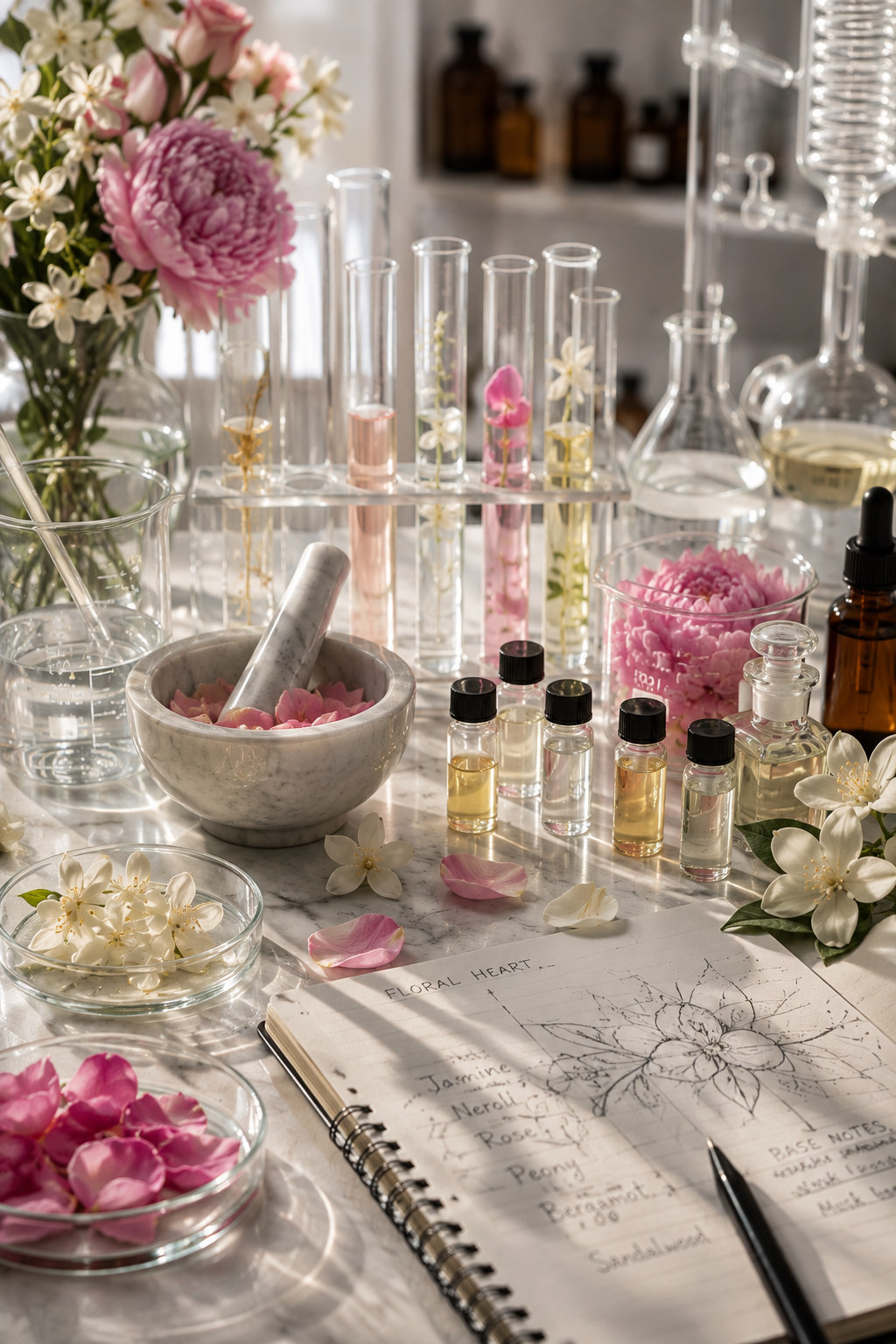
Perfume notes on a box sound straightforward until you realize that the jasmine you're smelling might contain zero actual jasmine, and the "woody base" your skin is drinking up could be a synthetic molecule your nose interprets differently than anyone else's. The vocabulary of fragrance notes was built for marketing before it was built for accuracy, and that gap is worth closing.
When a fragrance label lists its notes, it's giving you a creative brief, not a recipe. Those words describe the impression a perfumer intended. They're not an ingredient list. The actual chemistry underneath can be wildly different from what the language suggests.
Understanding this doesn't make fragrance less magical. It makes you a smarter, more confident wearer.
Not sure which MAIR fragrance is yours? The quiz takes 60 seconds.
Top Notes Aren't the Fragrance. They're the Introduction.
Top notes are what hits you in the first 30 seconds. Bergamot, lemon, pink pepper. Bright, sharp, immediate. They exist specifically to draw you in and they evaporate fast, sometimes within five minutes on warm skin.
Most people smell a fragrance in-store, love those top notes, spray it on their wrist, and then wonder why it smells different an hour later. It's because those top notes were never meant to stay. They're the handshake, not the conversation.
This is why sampling matters. If you want to know whether a fragrance is actually your fragrance, you need to let it dry down fully and meet the heart and base. That's where the real character lives. MAIR's Discovery Kit exists precisely for this reason , so you can wear each scent through its full arc before committing.
Learn more about what that arc actually looks like at the chemistry level in how perfume is made, from raw ingredients to the final bottle.
The "Rose" in Your Perfume Probably Isn't Rose
Natural rose absolute is one of the most expensive raw ingredients in perfumery. It takes roughly 4,000 kilograms of rose petals to produce a single kilogram of absolute. The economics make it prohibitive at scale, so most mainstream fragrances use synthetic molecules like rose oxide or geraniol to replicate the effect.
That's not inherently a problem. Skilled perfumers can construct a rose accord so convincing that it outperforms natural rose in complexity and longevity. But it does mean the note you think you're smelling is often a constructed impression, not a direct extraction.
The same is true for notes like violet, lily of the valley, and gardenia. These flowers don't yield extractable aromatics in any meaningful commercial quantity. Every violet note you've ever loved was built molecule by molecule in a lab. Understanding this completely reframes how you read a fragrance label.

Why Your Skin Changes the Notes Entirely
Fragrance doesn't perform in isolation. It performs in conversation with your skin's chemistry, its pH, its temperature, its natural oils. Two people can wear the same fragrance and generate genuinely different scent profiles. This isn't folklore. It's chemistry.
If a woody note clings on your skin for hours but vanishes on your friend in thirty minutes, that's your skin's pH interacting differently with the aromatic compounds. If a floral note that reads soft in the bottle turns sharp on your pulse points, your skin temperature is amplifying specific molecules while others recede.
Your skin isn't a neutral surface. It's a collaborator. Understanding your skin's pH is one of the most practical tools you have for choosing a fragrance that actually works for you.
The most powerful thing you can do as a fragrance wearer is stop trusting the label and start trusting your skin.
Base Notes Are Where Fragrance Becomes Identity
Base notes are the slowest to emerge and the longest to last. Musks, ambers, resins, sandalwood, vetiver. These are the notes that linger on your skin hours after application and still live faintly in the fabric of your coat the next morning.
They're also the notes that are most personal. Because by the time your skin reaches the base, it has metabolized the fragrance through its own chemistry. What you're smelling at hour four is genuinely yours. Not the brand's. Not the perfumer's. Yours.
This is the principle that sits at the center of every MAIR fragrance. Remember When was built with a base designed to anchor without overpowering, so the warm amber and skin musks read as an extension of the wearer rather than a statement imposed on them. Peony Silk layers a sheer floral heart over a soft musk base for the same reason. Fragrance should feel like revelation, not performance.
The note pyramid is a useful framework. But it was never the full story. Knowing what's actually happening beneath those marketing words means you stop chasing labels and start chasing what your skin does with a scent. That's the difference between wearing a fragrance and owning it. And it's one of the most quietly powerful things you can know about yourself. For a deeper look at how longevity connects to fragrance construction, this guide on which fragrance categories last longest is worth your time.
Not sure which MAIR fragrance is yours? The quiz takes 60 seconds.