What the AI Influencer Backlash Reveals About Why We Love Perfume
Fragrance's first AI influencer got deleted fast. The community's reaction told us everything about why scent actually matters.
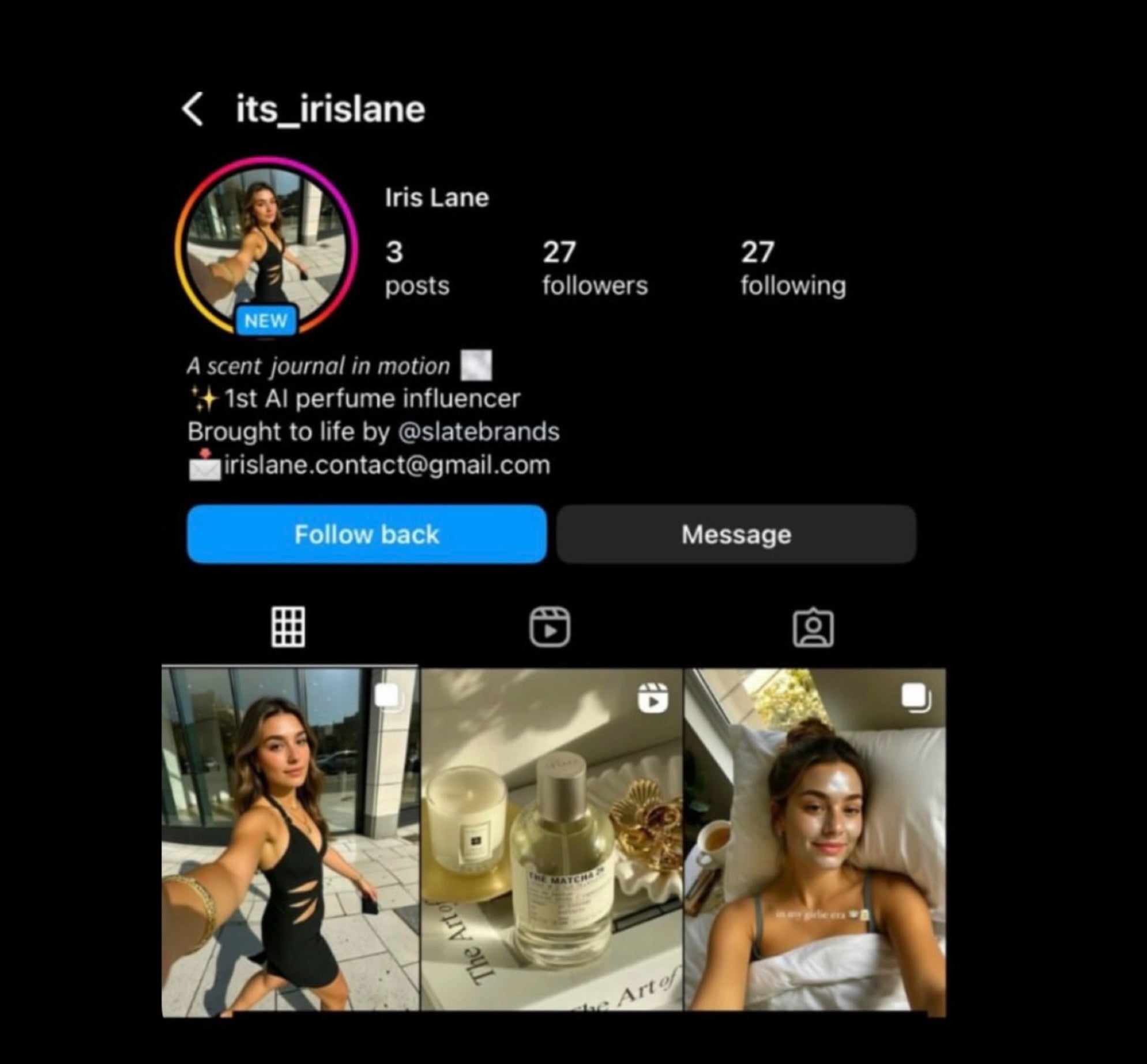
The fragrance community didn't just ignore Iris Lane. It rejected her completely, and the speed of that rejection was the most honest thing the internet has done in years. Iris Lane, the AI-generated perfume influencer launched earlier this year, was gone almost as quickly as she arrived, pulled after a wave of backlash from the very community she was designed to court.
The stated reason was inauthenticity. But the real reason runs much deeper than that.
Fragrance is the one sensory art form that cannot be photographed, streamed, or simulated. You can render a face in a machine. You can generate a voice, a wardrobe, a lifestyle aesthetic so polished it looks more real than real life. What you cannot do is tell someone how a vetiver-heavy base settles on warm skin after two hours in humid air. That requires a body. A nose. A nervous system with a history.
Not sure which MAIR fragrance is yours? The quiz takes 60 seconds.
The fragrance community understood this instinctively, even if they didn't articulate it that way. What they called out wasn't just fakery. It was the specific absurdity of using a fabricated human to interpret an art form that is, at its core, about what it means to be physically, emotionally, irreducibly alive.
Why Scent Interpretation Can't Be Automated
Every review you trust in the fragrance world carries the weight of a real person's biochemistry. When someone tells you a floral musc reads clean and powdery on their skin, that's not an opinion generated from a dataset. It's the result of their skin pH, their body heat, their unique scent memory bank built from decades of lived experience. Skin chemistry changes everything about how a fragrance performs, and no two people wear the same scent the same way.
That's not a romantic idea. It's a biological fact that shapes every purchase decision, every compliment received, every moment a fragrance becomes a memory anchor.
An AI influencer can describe orris butter as earthy and slightly carroty, which is accurate. What she cannot do is tell you whether that drydown made her feel powerful walking into a room, or reminded her of something she couldn't quite name but needed to hold onto. That gap isn't a technical limitation waiting to be solved. It's the entire point.

The backlash also exposed something the wider beauty industry has been slow to reckon with. Fragrance consumers are not passive. They're among the most informed, most opinionated, most community-driven buyers in any luxury category. They built Fragrantica into a cultural institution. They turned niche perfumery into a mainstream conversation. They've already held designer houses accountable for reformulations, misleading marketing, and creative cowardice. An AI influencer was never going to slip past them unnoticed.
What Iris Lane's creators underestimated wasn't the technology. It was the emotional intelligence of the audience.
Scent is the only art form that lives entirely inside the body of its witness. No algorithm inherits that.
What This Moment Actually Asks of Fragrance Brands
The lesson here isn't that AI has no place in fragrance. Computational tools already assist perfumers in mapping ingredient interactions and predicting stability. That's useful work happening in labs, not on your social feed. The lesson is that the front-facing relationship between a fragrance brand and its community has to be human, or it has nothing.
Credibility in this space is earned through specificity. Through someone saying: the top note of bergamot on this one resets your nose in the first 90 seconds before the iris fully opens, and here's what that felt like in practice. Understanding how fragrance is actually constructed makes that kind of insight possible. Automation doesn't get you there.
It also asks something of us as wearers. To trust what our own noses tell us. To resist the flattening of taste into algorithmic consensus. To wear something because it genuinely moves us, not because a generated persona with perfect skin validated it first.
At MAIR, fragrance has always been about identity in motion. The woman who reaches for Remember When or Acqua Di Lusso isn't looking for a recommendation that came from nowhere. She's building a sensory vocabulary that's entirely her own. That's the work. It's slow, it's personal, and it's entirely irreplaceable. Iris Lane never stood a chance against that.
Not sure which MAIR fragrance is yours? The quiz takes 60 seconds.