How To Make A Fragrance At Home

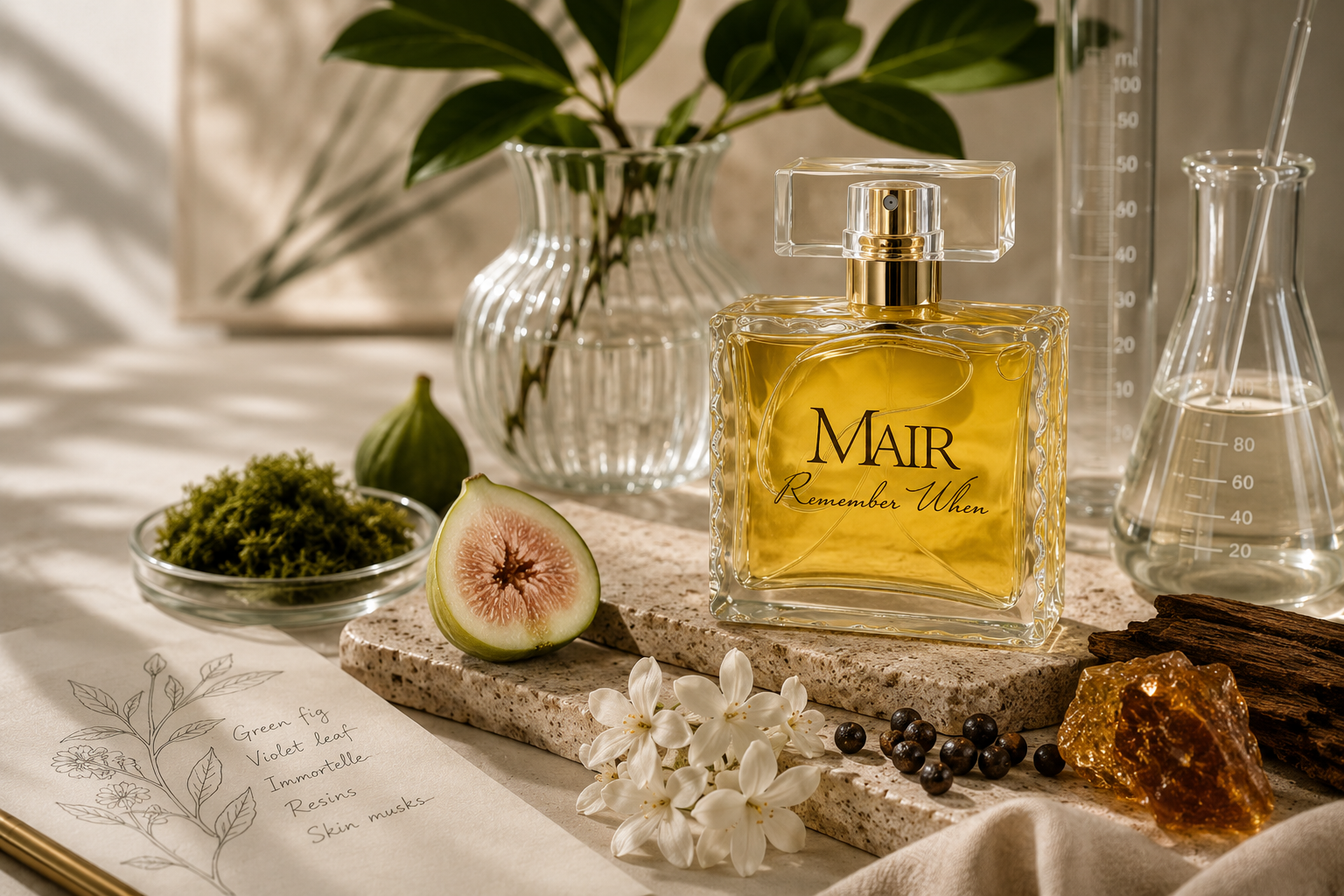
When I think back on my journey building Mair, I remember all the different paths I could have taken. Before there were factories, retailers, and business plans, there was me at home with a few oils, a notebook, and a lot of curiosity. That at-home experimenting taught me how my nose works, what I actually like, and how powerful scent can be. If you want to explore perfume for yourself, starting at home is a beautiful first step.
This is not about becoming a professional perfumer overnight. It is about playing, learning, and paying attention so you can understand fragrance on a deeper level.
What You Need To Get Started
You do not need a lab to make a simple fragrance at home. You only need a few basic tools and a little patience.
A neutral base: perfumer’s alcohol or high-proof vodka for a spray, or jojoba oil for a skin oil.
Essential oils and/or fragrance oils: start with just a few you already love, such as citrus, vanilla, lavender, or sandalwood.
Small glass bottles: dark glass helps protect your blend from light.
Pipettes or droppers: so you can count or measure drops and repeat what works.
Blotter strips or small pieces of unscented paper for testing.
A notebook or notes app to record every experiment.
The goal is consistency. If you discover a blend you love, you need to know what you did so you can make it again.
Learn The Basic Structure: Top, Heart, Base
Most perfumes follow a simple structure that you can use at home.
Top notes are what you smell first. They are bright and light, like lemon, grapefruit, or mint.
Heart notes appear after the top fades. They are the main theme, like jasmine, rose, or spices.
Base notes are the foundation. They last the longest on your skin, like vanilla, woods, or musk-type notes.
When you blend, think in terms of a rough ratio such as:
30% top notes
40% heart notes
30% base notes
You do not need to be perfect. This is just a guide to help your fragrance feel complete instead of flat.
"Making fragrance at home is not about perfection. It is about training your nose, trusting your instincts, and learning what you truly love."
Step-By-Step: Blending Your First Simple Fragrance
Start small. It is easier to adjust a test blend than a big bottle.
-
Start with your base notes
Choose one or two base notes you really enjoy, such as vanilla and sandalwood. Add a small number of drops of each into your bottle. This is the "anchor" of your fragrance. -
Add your heart notes
Next, choose one or two heart notes that feel like the personality of your fragrance. Floral, spicy, or soft herbal notes work well here. Add drops slowly, then smell on a blotter strip. If the heart feels too weak, add a little more. -
Finish with top notes
Top notes will announce the fragrance. Citrus, light herbs, or green notes are common choices. Add them last so you can tell how they sit on top of the heart and base. -
Smell, pause, then smell again
Right after mixing, your blend will smell harsh or confused. Give it a few minutes. Smell on a blotter strip, then again after 10–15 minutes. Make small adjustments if something is clearly too strong. -
Let it rest
If you can, leave the bottle closed for 24–48 hours. This gives the ingredients time to mingle. When you come back, smell again on a strip, and then test on your skin.
Test On Skin, Not Just Paper
Paper gives you a first impression, but your skin tells the real story. Your body heat, pH, and natural scent change how a perfume behaves.
Apply a small amount to your wrist or inner elbow.
Do not rub it in; let it dry naturally.
Smell it right away, after 30 minutes, and after a few hours.
Notice how it opens, how it settles, and what is left at the end of the day. A simple at-home fragrance that still smells interesting after a few hours is a good sign that you are on the right track.
Keep Notes So You Can Learn
One of the most important parts of making fragrance at home is recording what you do.
Write down:
The exact number of drops or measurements for each ingredient.
How it smelled right after blending, after one day, and after one week.
What you liked and did not like: too sharp, too sweet, not strong enough, and so on.
Over time, you will notice patterns. You will see which notes you always reach for, which ones dominate too easily, and which combinations surprise you in a good way. This is how your personal style starts to form.
Know The Limits Of At-Home Fragrance
It is important to stay safe and realistic about home blending.
Essential oils can be strong and irritating at high levels, so always dilute properly and avoid putting undiluted oils directly on skin.
Some materials used in professional perfumery are not available or not safe to handle at home.
A simple home blend will not behave exactly like a professionally composed perfume, and that is completely fine.
Think of this as sketching with scent. You are not trying to replace what a trained perfumer does in a lab. You are training your nose, building your taste, and understanding what you truly enjoy.
How This Connects To A Professional Brand Journey
For many founders, including me, the path to a finished, polished fragrance did not start with a factory. It started with questions like "What do I actually love to smell?" and "Why does this note feel like me?" Those questions can be explored at your kitchen table long before you ever talk to a chemist or manufacturer.
Making perfume at home helps you:
Develop your nose so you can give better feedback later.
Build confidence in your own taste instead of copying trends.
Appreciate the complexity and craft behind every finished bottle you buy.
Even if you never plan to launch a brand, this process can deepen your relationship with fragrance. You stop chasing hype and start choosing scents that feel right for you.