Why Does Every Luxury Brand Suddenly Want to Smell Like Something?
I started noticing something.
Some of the most memorable scent experiences I have had lately haven't necessarily come from perfume bottles.
They have come from hotels, stores, spas and other spaces where fragrance seems to have been considered just as carefully as the lighting, furniture or music.
And it made me wonder, when did scent become part of a brand identity in the same way as a logo, color palette or typeface?
Once I started looking, I realized fragrance is playing a much bigger role in branding than I thought.
A brand used to be something you could recognize with your eyes
Think about some of the world's most recognizable brands.
You probably associate them with a color, logo, packaging style or particular design language before you ever think about how they smell.
That makes sense. Branding has historically been dominated by what we can see.
Companies spend years developing visual identities and then protect them relentlessly. There are rules for logos, fonts, photography, packaging, store design and even the amount of empty space that should surround a logo.
But a customer walking into a physical space isn't experiencing a brand with only their eyes.
They hear it.
They touch it.
And whether the company intended it or not, they smell it.
That's where scent marketing gets interesting
Scent marketing is the deliberate use of fragrance to shape the way people experience a brand or physical environment.
Sometimes the goal is straightforward: make a space smell pleasant.
But sophisticated scent branding goes further. The fragrance is selected or created to feel consistent with the identity of the company itself.
A bright coastal resort may want something airy, citrusy or aquatic. A dark, intimate luxury hotel may lean toward woods, amber or spice. A wellness environment might choose something botanical or calming.
The question becomes less "What smells good?" and more:
"What should being here smell like?"
That is a very different branding question.
Hotels understood this early
Hospitality provides some of the clearest examples because hotels aren't simply selling rooms. They are selling an environment.
Westin, for example, became closely associated with its White Tea scent, which has been used throughout its properties and expanded into home fragrance and bath products guests can purchase for themselves.
That creates an interesting loop.
You experience the fragrance while traveling. The scent becomes associated with the hotel. Then you can bring that fragrance home and recreate part of the experience.
The product isn't simply a diffuser anymore.
It becomes a souvenir of a feeling.
I explored this more closely in why hotels smell so good and how signature hotel scents are created.
Retailers have been experimenting with our noses too
Retail is particularly interesting because scent becomes part of an environment where people are already making purchasing decisions.
Research into ambient scent has found that fragrance can influence how consumers perceive and remember environments and brands. Other research has explored relationships between ambient scent, time spent in stores, product evaluation and purchasing behavior.
That doesn't mean pumping fragrance into a store magically makes people buy more.
Context matters.
A scent that feels completely disconnected from the environment can be distracting rather than persuasive. The interesting part is what happens when the scent, visual design, music and overall experience reinforce one another.
The fragrance stops feeling like something that was added to the space.
It starts feeling like it belongs there.
Can a brand have a signature scent?
This is the question I kept coming back to.
We talk constantly about people having signature scents. A fragrance becomes so closely associated with someone that smelling it can immediately make you think of them.
So why couldn't the same thing happen with a company?
Repeated exposure creates association.
You smell something in the same hotel every time you visit. Or every time you walk into a particular store. Eventually, the fragrance and the brand begin occupying the same space in your memory.
That connection is especially interesting because our sense of smell has a powerful relationship with memory and emotion. I've written before about why scent can trigger such vivid memories.
Suddenly, a signature scent doesn't sound very different from a signature color.
Both are sensory shortcuts back to an identity.
Discover MAIR
Three fragrances. One might feel like you.
Experience Remember When, Peony Silk and Acqua Di Lusso before choosing your full-size fragrance.
Explore the Discovery KitEcommerce may actually make scent more valuable
This was the part I hadn't considered when I first started thinking about scent branding.
The more commerce moves online, the more unusual a truly sensory brand experience becomes.
A website can show me what something looks like.
Video can show me how it moves.
Audio can let me hear it.
But my laptop still can't make me smell the lobby of a hotel, the inside of a boutique or a fragrance on my own skin.
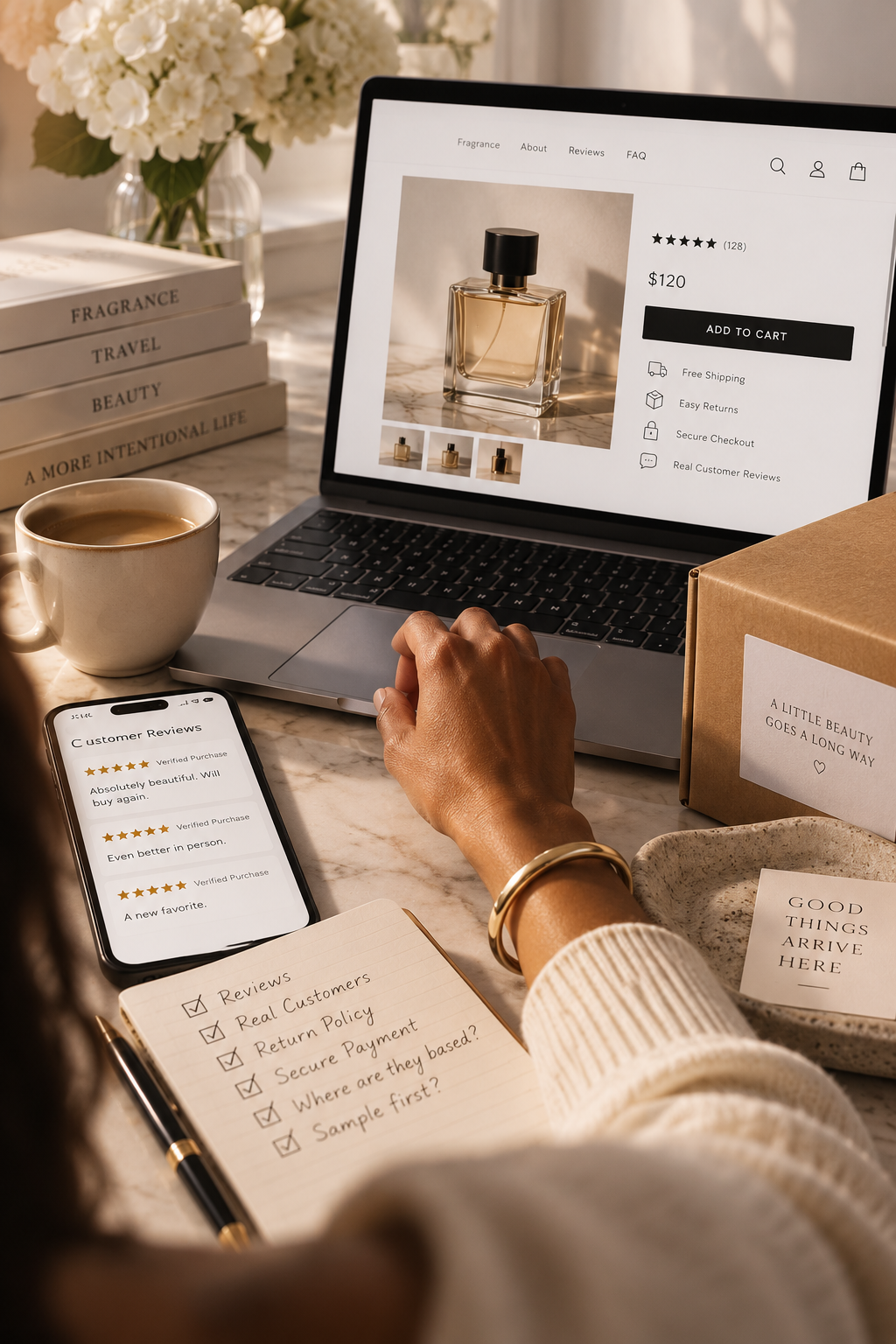
That limitation is particularly obvious in fragrance. As I explored in how we decide whether to trust a brand we can only buy online, perfume companies are asking customers to purchase one of the few products whose defining characteristic cannot be experienced through a screen.
But I think there is another side to that problem.
If so much of shopping is becoming digital, then the things a screen cannot reproduce may become more valuable, not less.
A beautifully scented store gives you something a product page cannot.
It gives you a physical memory.
But scent can't rescue a brand that doesn't make sense
There is a temptation with any branding trend to treat it like a checklist.
Beautiful logo? Check.
Great packaging? Check.
Signature scent? Check.
But sensory branding only becomes interesting when the pieces belong together.
If a company's visual identity says one thing while the physical environment smells like something completely unrelated, adding fragrance isn't strengthening the brand. It is adding noise.
The same principle applies to perfume itself.
Packaging can influence how we perceive a fragrance before we ever spray it, something I explored in the relationship between perfume packaging and consumer perception. But eventually, the bottle, fragrance, story and experience have to make sense together.
The strongest brands don't simply accumulate beautiful things.
They create a world where those things feel related.
Maybe we've been thinking about brand identity too narrowly
I started with a fairly simple observation: more companies seem to care about how their spaces smell.
But the deeper I went, the more I started questioning the way we think about branding itself.
We spend an enormous amount of time asking what a brand should look like.
Maybe the better question is:
What should it feel like to encounter it?
What should you see?
What should you hear?
What should you touch?
And yes, what should you smell?
Because a logo can help someone recognize a company.
But recognition isn't quite the same thing as memory.
And the brands that stay with us tend to give us something more than a logo to remember.
Find Your Scent
What fragrance feels like you?
Not sure which MAIR fragrance is yours? The quiz takes 60 seconds.
Take the Scent Quiz →