Why Perfume Dupes Smell So Similar to Designer Fragrances, But Never Exactly the Same
The dupe economy has a great pitch: same scent, fraction of the price. And on first spray, it's hard to argue. But first spray isn't the whole story, and the fragrance industry knows it.
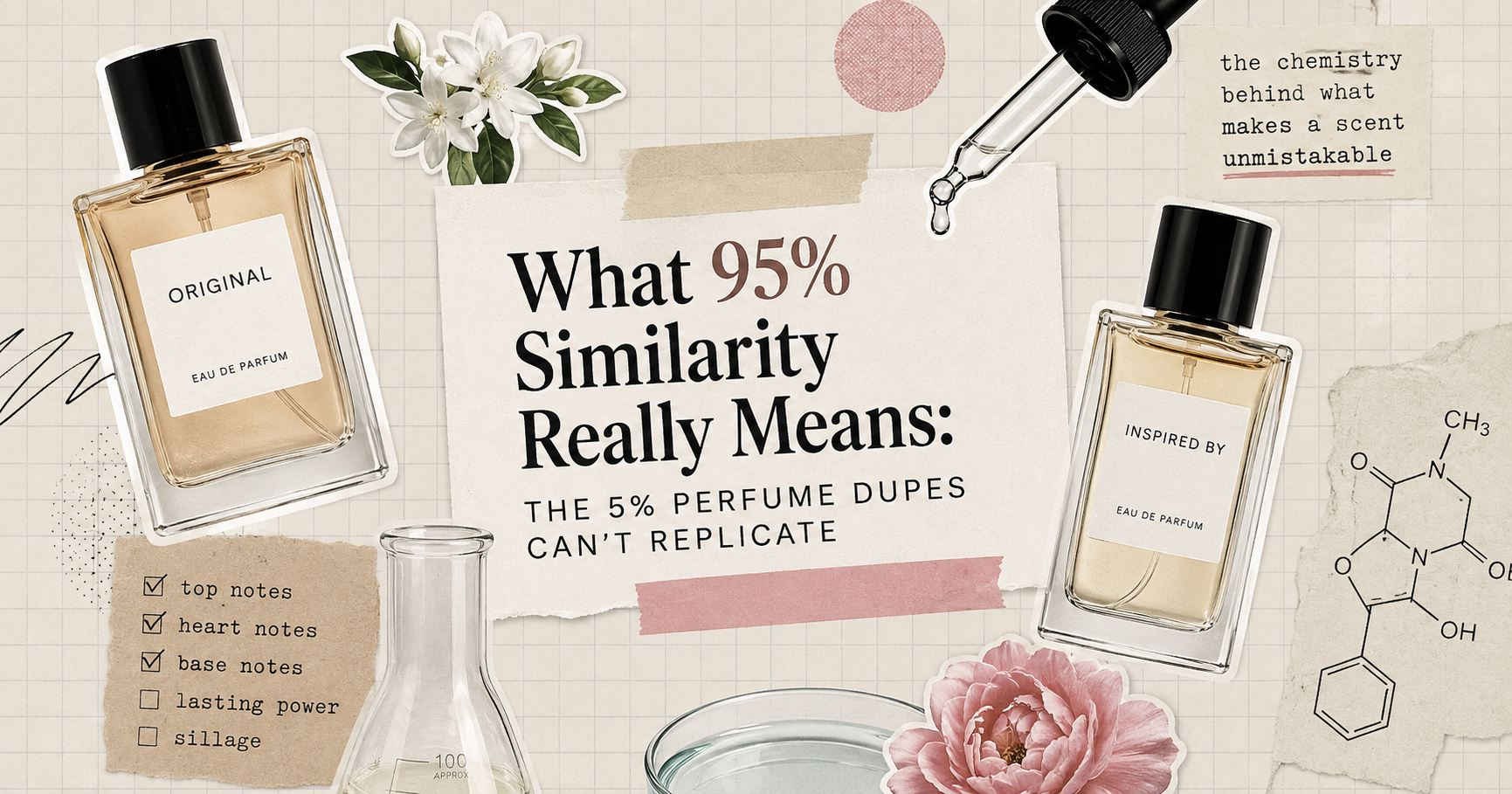
Dupe houses work with some of the world's most sophisticated flavor and fragrance suppliers to legally reverse-engineer bestselling scents. Gas chromatography breaks a fragrance down to its molecular components. Trained perfumers reconstruct it. The result can hit 95% chemical similarity. That number is real. What it can't capture is the 5% that actually makes a fragrance worth wearing.
Understanding what lives inside that 5% changes how you shop, how you layer, and how you think about what perfume actually does on your skin.
Not sure which MAIR fragrance is yours? The quiz takes 60 seconds.
What Molecular Replication Can and Can't Do
Gas chromatography identifies what molecules are present in a fragrance. It does not identify why specific raw material grades were chosen, where those materials were sourced, or how the perfumer weighted each component in relation to the others. Those decisions don't show up in a readout.
Take jasmine. A lab can identify jasmine absolute as a component. What it can't replicate is whether that absolute came from Grasse, where the flower's harvest window is 72 hours long and the picking starts before dawn to preserve volatile compounds. The chemical profile of Grasse jasmine and commodity jasmine are similar. The olfactory reality is not. The families who grow these flowers have been perfecting that difference for generations.
Dupe houses substitute. They have to. Sourcing rare-grade naturals at scale is expensive and often impossible. Synthetic alternatives close the gap in structure but not in soul. The top notes read correctly. The rest of the fragrance's arc begins to drift.
The Drydown Is Where Dupes Fall Apart
A fragrance has three acts. The top notes last roughly 15 to 30 minutes. The heart settles in after that. The drydown, the base, is what clings to your skin six hours later. It's also where raw material quality shows up most brutally.
Natural musks, aged woods, and resinous base materials behave differently on skin than their synthetic counterparts. They warm, they shift, they develop. Synthetic bases often fix in place. What you smell on first spray is more or less what you'll smell on hour six. That flatness isn't a flaw in the formula. It's a direct consequence of ingredient substitution.

Your skin chemistry is the other variable no replication formula can account for. Skin pH, hydration levels, even your diet influence how fragrance molecules bind and evaporate. Skin pH alone can shift a fragrance's character significantly across wearers. A dupe calibrated to smell a certain way in a bottle or on a blotter has no mechanism to adapt to you. A well-constructed fragrance, built with high-grade naturals, does adapt. That's not marketing. It's chemistry.
The materials drive the behavior. And the materials cost money. The real cost of luxury fragrance lives in those sourcing decisions, the ones that don't appear on a spec sheet and can't be reconstructed from a chromatography readout.
A dupe can copy a fragrance's opening. It cannot copy the decision to source better, the hours of drydown that follow, or the way a great material meets your skin and becomes something entirely your own.
The 5% Is a Philosophy, Not a Formula
What sits in that uncopyable 5% isn't a secret molecule or a proprietary accord only one lab holds. It's a series of intentional decisions made before a fragrance ever reaches your skin. Which version of a raw material. Which grade. Which harvest. How much concentration. How much patience.
At MAIR, those decisions are built into every fragrance from the start. Not because luxury is the goal, but because a fragrance that performs well on your skin, develops over hours, and leaves something worth remembering requires materials that can actually do that work.
Fragrance is one of the most intimate things you wear. It lives at the edge of your body and your presence. It deserves to be built with intention, not approximation. The dupe economy offers a copy of a moment. The real thing offers a full experience, one that belongs to you and shifts with you across an entire day.
That's what the 5% protects. And it's worth knowing exactly what you're choosing.
Not sure which MAIR fragrance is yours? The quiz takes 60 seconds.